
Arrest Warrants in Roosevelt County
Two state rules govern the paper itself. New Mexico Form 9-210 and Rule 6-206 lay out what a Roosevelt County arrest warrant must carry: court and case information, the charge, the probable-cause or issuance text, directions to qualified law enforcement, where it may be executed, system entry, and return fields. The court alone controls issuance and removal; an agency only executes or attempts service. On the division of labor, District Court generally takes felonies and other general-jurisdiction criminal matters, while Magistrate Court handles its statutory criminal and preliminary cases. Whatever the instrument, the first status question belongs with the court named in the case.
What a Roosevelt County Arrest Warrant Contains
The blank form explains a Roosevelt County warrant record without exposing anyone's information. The fields below describe the court process, using an anonymous sample number.
| Court and cause number | State, county, city, court, and case identifier such as D-XX-CR-0000. |
|---|---|
| Charging agency | The police or law-enforcement agency connected to the charge or complaint. |
| Offense and probable cause | Charge description and issuance text reviewed by the court, subject to public-access limits. |
| Officer direction | Instruction to qualified law enforcement to arrest and bring the defendant before the court. |
| Return and removal | Where found, arrest or service date, system entry, removal, and officer return information. |
How Roosevelt County Arrest Warrants Are Issued
In Roosevelt County, an arrest warrant starts with Form 9-210. A complaint or other charging information goes to the judge. The judge weighs probable cause under the governing rule. If the judge signs, the warrant directs qualified officers to act. It may spell out where it can be executed and which law-enforcement system receives it. To learn which judge handles a matter, use the court's official contact route rather than guessing from an assignment list. A separate 2024 announcement describes an electronic-warrant pilot involving courts, DPS, and New Mexico State Police. That modernization moves the system forward, but it creates no public name-search database and puts no full warrant record online.
Service Roles for a Roosevelt County Arrest Warrant
Form 9-210 can be directed to qualified state, county, municipal, campus, tribal, or Pueblo officers when the warrant and jurisdiction allow. For a Roosevelt County matter, the practical agency may be the Sheriff's Office, Portales Police, New Mexico State Police, or another authorized office. No separate county constable or marshal portal exists here.
Arrest Warrant, Summons, and Bench Warrant
Courts use several instruments, and each leads somewhere different. A summons or citation asks for a response or appearance. An arrest warrant, once the issuance standard is met, directs qualified officers to arrest and bring the defendant before the court. A bench or FTA warrant follows a missed court obligation or other noncompliance. Read the label in any public result together with the court and case type.
| Instrument | Typical basis | First question |
|---|---|---|
| Arrest warrant | Probable-cause issuance for an alleged offense. | Which court issued it and what release process applies? |
| Summons or citation | Notice to respond or appear. | What date, court, and response are required? |
| Bench warrant | Failure to appear, release, contempt, probation, or another court event. | What court-approved appearance or cancellation process applies? |
What Service and Removal Fields Mean
Law-enforcement and court systems stamp separate times for entry, service attempt, arrest, return, and removal. A 'served' or 'returned' label does not tell you the release terms or the case outcome. A court cancellation order is also different from an officer simply failing to locate someone. Ask the issuing court which event controls the current record.
- Service
- Execution or attempted execution of the court direction.
- Return
- Agency information reporting arrest, service, custody, or inability to serve.
- Removal
- An authorized system update after the court ends or changes the warrant.
- Release conditions
- Requirements ordered by the court after appearance or custody.
Confirming a Roosevelt County Arrest Warrant
Start with Case Lookup, then match the case location and number against your notice. Next, call the court at its current number. Ask whether the warrant is still active, whether counsel should arrange an appearance, whether it is bailable, which court sets conditions, and whether a scheduled surrender is available. The detention page publishes no complete local bond window or payment method, so confirm those details before you travel anywhere in Roosevelt County.
Important: Do not test a possible arrest warrant at a random counter or rely on a threatening caller. Verify the court and ask counsel about safe next steps.
New Mexico Courts warns about callers demanding immediate payment through a bonding company over alleged jury-service warrants. Hang up, then find the court number on your own.
State and Federal Arrest Warrant Boundaries
Roosevelt County and New Mexico court pages stop at the state line. The District of New Mexico keeps federal locations outside the county, and PACER may show public docket material while sealed or unserved warrants stay hidden. For anything federal, contact a federal clerk, counsel, or an authorized federal agency. Never treat a state result as a federal answer.
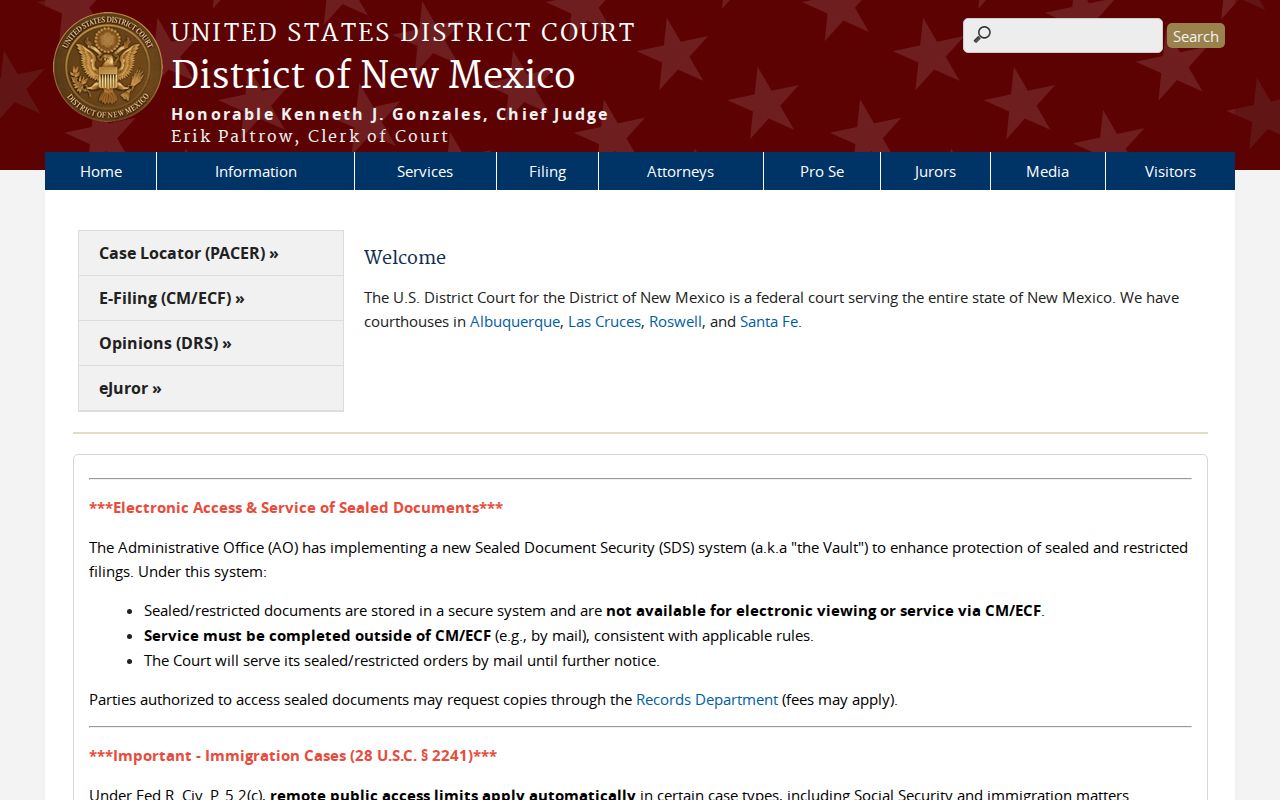
The federal court page illustrates that separate jurisdictional route. It is not a federal warrant search, and it shows no fugitive roster.
Public Access to Roosevelt County Arrest-Warrant Records
New Mexico IPRA supports public inspection, subject to statutory exceptions. Court access policy redacts personal identifiers and excludes sealed, confidential, juvenile, and other protected material. Probable-cause text or an underlying affidavit may not be fully visible. A public search is never a complete warrant dossier.
Records rule: Request a court order or docket event from the issuing court, and ask the Sheriff's Office only for the agency records it maintains. Do not ask for or republish a private-person roster.
For public research, request aggregate service counts, blank forms, policies, or redacted fields with a date range. Leave names out. Unless an official custodian explains a lawful need, keep identifying fields out of the request.
Arrest Warrant Resolution Starts With the Court
Only the court can move things forward. It may require an appearance, a surrender, bond or release review, counsel, or another case-specific action; a law-enforcement employee generally cannot cancel a court warrant over the phone. Once the court acts, keep the docket entry, order, release conditions, or receipt, and ask when the system should show removal. A current Most Wanted page is a curated felony alert, never a complete warrant check. Don't approach a listed person. Send public-safety tips through the named official route, and take personal status questions to the Roosevelt County court.